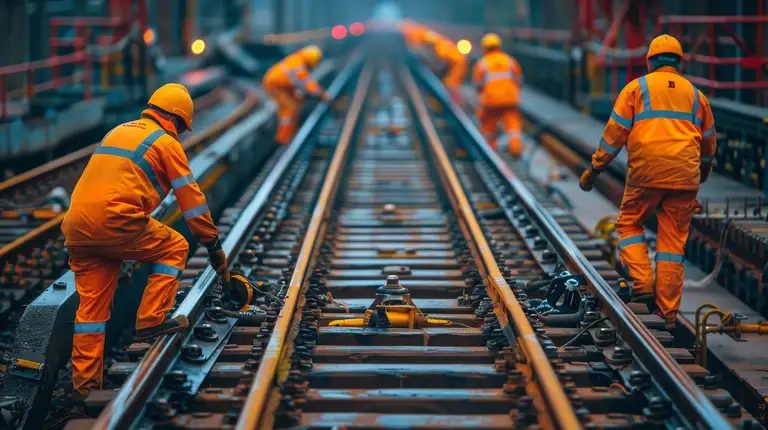
Visibility, Vigilance, and Visibility Again: High-Visibility in Rail Environments
When people think of working on railway lines, they often imagine the physical responsibilities of the job: lifting, maintaining, repairing, or inspecting equipment. However, one of the most significant things in keeping rail workers safe is far less obvious but equally important: tools and training. It is the appropriate type of high-visibility clothes. Wearing the appropriate railway clothing is not a ‘nice to have’ in the railway setting, where trains might pass at high speeds and line-side hazards can be difficult to identify from a distance. It is an essential part of safe working practice.
The goal of high-visibility apparel is simple: help others notice you quickly, clearly, and consistently. Railroads have larger stakes than many other sectors because to the combination of speed, weight, and limited stopping distances. Even if everyone on site is trying their best, things can change quickly. Weather can lessen contrast, lighting can be poor, and background objects like fencing, foliage, ballast, or structures might obscure the outline of a person at the track. Correct railway clothing is intended to eliminate these uncertainties by boosting visibility in a predictable manner.
The fact that railway clothing promotes safe interaction with train drivers and other trackside workers is a major factor. Train drivers may be responsible for responding to signals and navigating complicated routes, and they rely largely on early detection of passengers and obstacles. High-visibility clothes can transform a possibly “late notice” situation into a “early notice” situation. That extra time can mean the difference between a driver being able to change their speed adequately and a near-miss turning into an accident. Railroad workers frequently have to move, reposition equipment, or respond to unexpected situations; therefore, apparel that retains visibility independent of body position is essential.
Correct railway clothing enhances recognition. Visibility is more than just being seen; it also means being understood at a glance. When the appropriate clothing is worn, a worker’s silhouette is more visible, especially from various angles. That clarity is important along the railway line, where employees may face trains from an angle, squat, walk between points of work or approach or leave the track fast. In those situations, uniform, well-designed railway clothing can serve as a visual indicator that the individual is a worker rather than a stationary item. This decreases the likelihood of confusion and aids in making acceptable risk decisions.
Another important element is that railway circumstances are always changing. It may be sunny when a shift begins, but cloud cover, glare, fog, or darkness might impair visibility within hours. The trackside environment also contains a variety of materials, such as ballast, which can produce brilliant scattered light, as well as gradients or bends, which can distort sightlines. Correct high-visibility apparel is designed to perform under these changing conditions. When workers wear railway clothing that is properly specified for train situations, the visibility elements of the clothing are more likely to remain effective in both natural light and at night, where reflective materials can play an important role.
Reflective and luminous qualities improve safety in different ways. Fluorescent material boosts visibility in daylight or under certain lighting situations by standing out from the background. In contrast, reflective components “light up” when exposed to an external light source, such as headlamps. On a railway line, external illumination can come from a distant train approach, while the worker may be partially concealed by equipment or trackside structures. Railroad apparel that combines bright and reflective features can thus enable better recognition than clothing that only uses one strategy. This dual contribution is one of the reasons why proper railway clothing is so important: the goal is to be visible in a variety of conditions that may arise during train operation, not only at one specific time.
There is also a human factors component. People in difficult settings can misinterpret distance, speed, and relative movement. A worker standing near a queue may not be able to properly notice how fast a train is approaching, especially if noise levels are influenced by wind, infrastructure, or the presence of other sounds. Similarly, a person concentrating on a task may be unable to maintain steady attention to approaching movement. Railroad gear cannot replace situational awareness, but it can help compensate for times when attention is diverted. When visibility improves, the likelihood of a prompt response increases, benefiting both the worker and others in the safety chain.
Correct railway clothing is required not just for trains passing on adjacent lines, but also for the context of trackside movements. Rail projects rarely entail just one operation at a time. Maintenance vehicles, plant equipment, and other staff may be travelling through the jobsite. There could be operational personnel directing access arrangements, or colleagues entering and exiting authorised locations. Railway clothing contributes to the development of a common visual language in such dynamic environments. Everyone can find each other faster, which aids coordination and lowers the possibility of unintended interference between work groups. Clothing designed for high visibility also assists supervisory staff in confirming that personnel are operating within the specified safety parameters.
It is also vital to note that “high visibility” is not a universal idea. Visibility features influence performance depending on their nature, construction, coverage, and placement. For example, if clothing provide insufficient coverage, a worker’s body may be obscured from certain angles. If reflective parts are not properly positioned or worn, the clothes may not effectively capture light. If the clothing is broken, faded, or not properly kept, its performance suffers, and the worker may appear less conspicuous than desired. That is why wearing the right type of railway clothing is important: the design must be appropriate for railway operations, not just general construction or traffic visibility.
Maintenance and proper use are components of the safety value. Clothing that is improperly laundered, stretched due to misuse, or stored in a way that destroys reflective surfaces will not provide the same level of visibility. Similarly, neglecting fit might lead to decreased effectiveness. If a garment is excessively loose, it may shift or conceal reflective parts as the worker bends or moves. If it is overly tight, it may limit movement, creating discomfort and even leading to distracted conduct. The appropriate railway clothing should be tailored to the worker’s activities, allowing for safe movement while keeping visibility characteristics in the proper placements.
The requirement for proper railway clothing is further emphasised by weather and contamination. Damp environments, dust, grease, and dirt can all diminish colour clarity and material reflectivity. Trackside job can be filthy, and clothing might get soiled faster than in an office setting. Railway clothing that is selected for rail-specific circumstances and correctly maintained provides more consistent visibility throughout the day. When clothing is ignored, the protection it provides may deteriorate, undermining the very purpose it was worn.
Last but not least, railway clothing represents a commitment to predictable safety, not just personal protection. Railroads rely on systems, processes, and disciplined behaviour. Wearing appropriate high-visibility clothing is one aspect of that discipline. It helps to guarantee that every worker is a consistent part of the safety picture, visible to drivers, coworkers, and anyone else in the operational environment. When individuals understand what to expect visually at racetracks, the whole risk profile improves.
In everyday language, the key point is that working near live trains requires more than just good intentions. The railway environment tolerates little error, and visibility is one of the few variables that workers can actively regulate. Choosing and wearing the appropriate high-visibility clothing, as well as using railway clothing correctly during the shift, allows for earlier discovery, clearer recognition, and greater communication through sight. It improves the worker’s safety while also contributing to the safety of those around them. Railway clothing is vital because it transforms “I was there” into “I was seen in time” in a job where speed, distance, and unpredictability are constants.